In the context of heavy - duty transportation, cement tank semi - trailers play a crucial role in the construction and infrastructure sectors. As a supplier of Cement Tank Semi Trailers, I often encounter inquiries regarding the fuel consumption of these specialized vehicles. Understanding fuel consumption is not only essential for cost - management but also for environmental considerations.
Factors Affecting Fuel Consumption
Trailer Design and Specifications
The design and specifications of a cement tank semi - trailer have a significant impact on its fuel consumption. The size and capacity of the tank are primary factors. Larger tanks, which can carry more cement, generally require more energy to move. A cement tank semi - trailer with a higher capacity will have a greater weight when fully loaded, and according to Newton's second law of motion (F = ma), more force is needed to accelerate and maintain the motion of a heavier object. This results in increased fuel consumption.
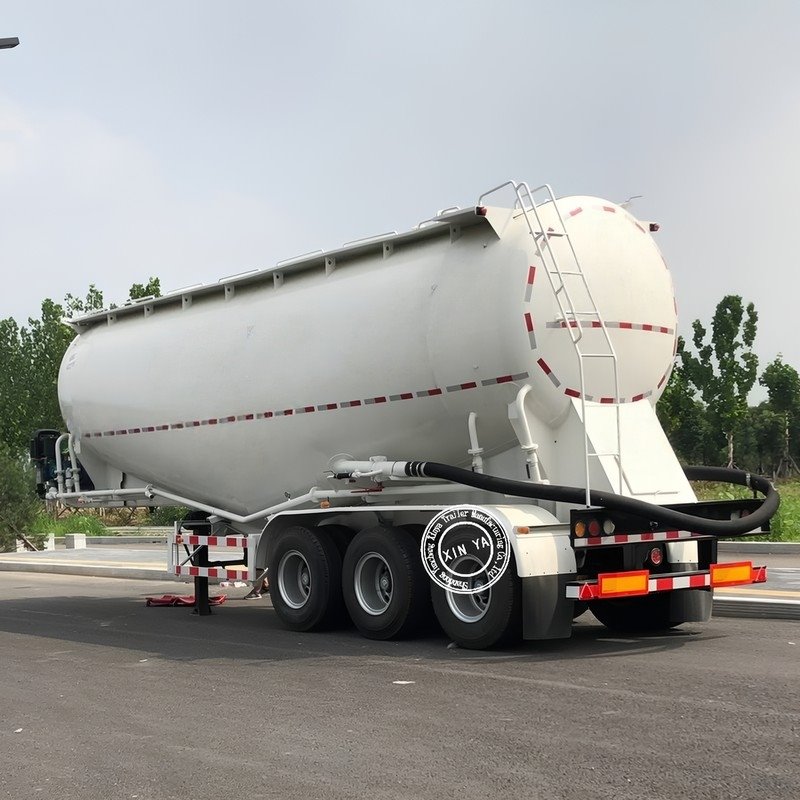
The shape of the tank also matters. A well - designed, aerodynamic tank can reduce air resistance. When a trailer is moving at high speeds on the highway, air resistance can account for a substantial portion of the total resistance the vehicle faces. Trailers with rounded and streamlined tanks experience less drag compared to those with boxy or irregular shapes. For example, a Cement Tank Semi Trailer with an aerodynamic design can cut through the air more efficiently, leading to lower fuel consumption.
Loading Conditions
The amount of cement loaded in the trailer is directly related to fuel consumption. A fully loaded trailer will consume more fuel than an empty one. This is because the engine has to work harder to move the additional weight. When calculating fuel consumption, operators need to consider the payload. In addition, how evenly the cement is distributed within the tank can also have an effect. An unevenly loaded trailer may cause the vehicle to have an unbalanced weight distribution, which can lead to increased tire resistance and steering difficulty. These factors can all contribute to increased fuel usage.
Driving Conditions
The environment in which the Cement Tank Semi Trailer is driven has a major impact on fuel consumption. Driving on hilly terrains requires more energy as the engine has to work harder to climb slopes. When going uphill, the vehicle has to overcome the gravitational force acting against it. On the other hand, driving on flat and smooth roads is more fuel - efficient.

Traffic conditions are also important. Stop - and - go traffic in urban areas forces the driver to frequently accelerate and decelerate. Each time the vehicle accelerates, it consumes a significant amount of fuel, and braking wastes the kinetic energy that the fuel has already been used to generate. In contrast, highway driving at a constant speed is generally more fuel - efficient.
Vehicle Maintenance
Proper vehicle maintenance is crucial for optimizing fuel consumption. Well - maintained tires with the correct tire pressure can reduce rolling resistance. Under - inflated tires increase the contact area between the tire and the road, which leads to more friction and higher fuel consumption. Regular engine maintenance, such as oil changes, air filter replacements, and spark plug checks, ensures that the engine operates at its peak efficiency. A poorly maintained engine may not burn fuel as effectively, resulting in increased fuel usage.
Typical Fuel Consumption Ranges
It is difficult to provide an exact figure for the fuel consumption of a cement tank semi - trailer because of the many variables involved. However, we can provide some general ranges based on industry experience.
On average, a medium - sized cement tank semi - trailer with a capacity of around 20 - 30 cubic meters, when fully loaded and driven on flat highways at a constant speed of around 80 - 90 km/h, may consume approximately 30 - 40 liters of diesel per 100 kilometers. For larger trailers with a capacity of 40 - 50 cubic meters, the fuel consumption can increase to 40 - 50 liters per 100 kilometers under similar driving conditions.
In urban or hilly areas with more challenging driving conditions, the fuel consumption can be significantly higher. A fully loaded trailer in stop - and - go traffic or on steep hills may consume 50 - 60 liters or even more per 100 kilometers.
Strategies to Reduce Fuel Consumption
Driver Training
Proper driver training can have a substantial impact on fuel consumption. Drivers should be trained to use smooth acceleration and deceleration techniques. Aggressive driving, such as rapid acceleration and hard braking, can increase fuel consumption by up to 30%. Maintaining a consistent speed is also important. Using cruise control on highways can help keep the speed constant and reduce fuel usage.
Route Planning
Careful route planning can help minimize fuel consumption. Avoiding congested areas and choosing routes with fewer hills and traffic lights can save a significant amount of fuel. Advanced GPS systems can be used to identify the most fuel - efficient routes based on real - time traffic information.
Trailer Technology
Advancements in trailer technology can also contribute to reducing fuel consumption. For example, some modern Cement Tank Semi Trailers are equipped with lightweight materials, such as high - strength steel or aluminum alloys. These materials reduce the overall weight of the trailer, which in turn reduces the energy required to move it.
Another technological innovation is the use of regenerative braking systems. These systems capture the kinetic energy generated during braking and convert it into electrical energy, which can be used to power auxiliary systems or recharge the vehicle's battery. This reduces the load on the engine and can lead to fuel savings.
Our Offerings as a Supplier
As a Cement Tank Semi Trailer supplier, we are committed to providing high - quality trailers that are designed with fuel efficiency in mind. Our trailers feature aerodynamic tank designs to reduce air resistance and are constructed using lightweight yet durable materials to minimize weight.
We also offer Dry Powder Tank Trailers and Powder Tanker Trailers, which are suitable for transporting various types of dry powders, including cement. These trailers are built to the highest standards of quality and performance, ensuring reliable operation and reduced fuel consumption over the long term.
If you are in the market for a cement tank semi - trailer or related products, we invite you to connect with us for a detailed discussion. Our team of experts can provide you with in - depth information about our products, including their fuel efficiency features, and help you choose the right trailer to meet your specific needs. Contact us today to start the procurement process and take advantage of our high - quality offerings in the transportation of cement and other dry powders.
References
- SAE International. "Fuel Efficiency in Heavy - Duty Vehicles."
- American Trucking Associations. "Guide to Reducing Fuel Consumption in Trucking."
- Society of Automotive Engineers. "Aerodynamics and Fuel Economy of Heavy - Duty Trucks."