

If you're in the market for a low loader semi-trailer, you already know one size does NOT fit all. I've been in the trailer supply game for years, talking to construction crews, farm operations, and industrial haulers every single week, and the #1 question I get isn't "how much is this thing?" It's "can I make this trailer work for my specific load?" The short answer? Hell yes. Low loaders are some of the most customizable pieces of rolling equipment out there, and there's a good reason-hauling a 40-ton excavator is way different than moving a small combine, which is way different than hauling a full load of steel beams. I'm gonna break down all the customization options we offer (plus the ones our customers actually ask for, not just the flashy stuff no one needs) and throw in links to the specific models we build for each use case, because why make you hunt around?
First off, let's start with the basics: low loaders (also called low beds, if you're chatting with old heads in the biz) are designed for hauling overheight loads that regular flatbeds can't handle-excavators, bulldozers, wind turbine components, even heavy farm equipment. That low deck is non-negotiable, but everything around it? Total playground for customization.
One of the most popular early decisions folks make is the gooseneck vs. fixed neck design. Wait, no, hold on-don't roll your eyes, this is a big one. A gooseneck low loader semi-trailer has that curved, tapered front neck that hooks up to the truck's fifth wheel, right? The big perk here is the weight distribution: the gooseneck sticks up over the truck, so a good chunk of the trailer's weight sits on the truck's axles instead of the trailer's rear axles. That makes it perfect for heavier loads because it balances the weight legally, so you don't get flagged for overloading on the trailer's rears. We've had customers use this for everything from compact track loaders to small road rollers, and honestly? It's the Swiss Army knife of low loaders. If you want to see the exact specs on these, like deck length, weight ratings, and optional add-ons, just check out our page for the Gooseneck Low Loader Trailer. Now, the alternative is a fixed (or straight) neck, which is more for super heavy, oversized loads where you don't want any of the trailer's weight on the truck-like hauling a whole excavator that's almost the same weight as a small car. But let's not get ahead of ourselves; neck design ties right into load capacity customization.
Speaking of capacity-this is another non-negotiable customization that isn't just about max weight, it's about what you can actually fit. We build everything from 25-ton low loaders up to 100-ton heavy duty units, and that 40-ton low loader semi-trailer is the workhorse we sell more than any other. Why 40 tons? It's the sweet spot for most general construction: excavators, pavers, small bulldozers, even stacked shipping containers (wait, no, stacked containers are better on a flatbed, but you get the idea). But if you're moving a 120-ton drill rig for a mine or a wind turbine tower section, you need that heavy low loader semi-trailer beefed up with thicker frame rails, more axles, and reinforced decking. The key here is that capacity isn't just about adding axles-we customize the frame's steel grade (we use high-tensile steel, not that cheap soft stuff that bends the first time you load a heavy machine) so it can handle the weight without sagging, and we can adjust the axle spacing too. Tighter axle spacing is good for tight turns on job sites, while wider spacing is better for highway stability at high speeds.
Now, let's get into the deck-this is where the real customizations happen, because the deck has to fit your load. First, deck length: we can build decks anywhere from 20 feet up to 50 feet. If you're hauling a compact skid-steer, 25 feet is more than enough, but if you're moving a 40-foot combine or a long excavator arm, you need that extra length. Then there's the deck surface: standard is smooth steel plate, but we can switch it to textured steel for better traction when loading heavy equipment (no more watching your operator's tracks slip while pulling up a 30-ton bulldozer). We also offer grated decks for loads that need air circulation-like if you're hauling heavy machinery with exhaust systems that get super hot, grating keeps air flowing so you don't get any heat damage. Oh, and removable deck sections! That's a big one. If you're hauling a load that's extra long, you can pop out a 5-foot section of the deck and extend the gooseneck or rear ramp to fit it-perfect for jobs where you don't need the extra length every day.
Next up: ramps. If you've ever tried loading heavy equipment without the right ramps, you know this is a dealbreaker. Standard ramps are steel, but we can customize them to be a bunch of different things. For smaller machinery like skid-steers, we have lightweight aluminum ramps that are easy to store and hook up, but for 40-ton excavators, you need heavy-duty steel ramps that can support that weight without bending. We also offer hydraulic ramps-those are lifesavers, honestly. Instead of cranking ramps up and down with a winch or struggling to fold them manually, hydraulic ramps let you lower them with a switch from the truck, which is way faster and safer, especially if you're working alone or on a busy job site. Another cool option is beaver tail ramps-those have that sloped rear section that sticks out a foot or two, so you don't have to drive your whole machine onto the flat deck. It reduces the angle you have to climb, which is a huge safety thing for operators when they're dealing with 20-ton loads. We can adjust the ramp angle too-steeper for shorter loads, shallower for super heavy stuff.
Then there's the suspension system, which people often sleep on, but it makes a massive difference for ride quality and load protection. Standard suspension is leaf spring, but we offer air ride suspension, which is ideal if you're hauling delicate loads-like wind turbine blades that can crack if they bounce too much on rough backroads. Air ride also makes highway driving way smoother, so your load doesn't shift around as much, and it's easier on the truck's tires too. For super heavy loads, we have hydraulic suspension that can handle way more weight than leaf spring or air ride, and it lets you adjust the height of the trailer-so you can lower it for loading heavy equipment, then raise it for highway clearance. That height adjustment is another customization we offer, by the way-some customers want a fixed low height for extra stability when hauling extremely low loads, others want adjustable height to switch between job site and highway driving.

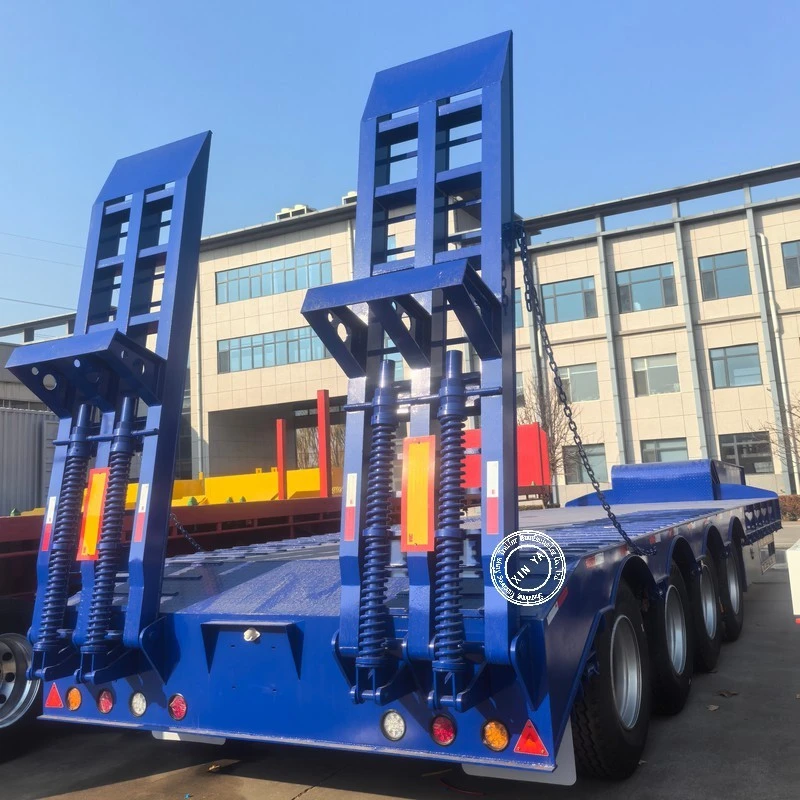
Smaller customizations that customers rave about? Let's get into those, because they're the stuff that makes your job easier. LED lighting is standard, but we can add extra work lights along the deck so you can load and unload at night without a generator. We can add toolboxes on the sides of the trailer, big enough for your straps, winch, and repair tools, so you don't have to carry a separate toolbox in the truck. Winches too-we can install electric or hydraulic winches on the deck to help pull heavy equipment up the ramps, which is perfect if you're working alone and don't have a spotter. Stake pockets along the deck sides are another popular add-on, so you can tie down irregular loads that aren't heavy machinery, like steel pipes or lumber. Even the color of the trailer is customizable-we match your company's logo colors, which is a big win for brand consistency on job sites.
Wait, let's talk about legal stuff, because customization has to be practical, not just cool. We work with every state's (and country's) weight and height regulations, so we can adjust the trailer's specs to make sure you stay compliant. For example, if you're hauling a 40-ton load in a state that allows 80,000 lbs total on 5 axles, we can set up the axle spacing and weight distribution to hit that exact limit, no overcharges or fines. That's why that 40-ton low loader semi-trailer page is so helpful-we've already got it calibrated for standard highway regulations, but we can tweak it for specific local rules too. For heavy loads that need oversize permits, we build our heavy low loader semi-trailers with all the necessary documentation prepped, so you don't have to do the headache of getting the trailer certified for oversize routes.
I should also mention that none of these customizations are one-size-fits-all. Last month, we had a customer who hauled vintage farm tractors-they wanted a low deck to keep the load stable, but also removable side rails so they could secure the tractors without scratching them, plus aluminum ramps that were lightweight enough for their small truck to pull up. We built a custom gooseneck trailer with exactly those specs, and they've been using it nonstop ever since. Another customer was a construction company that hauled long steel beams, so we customized a fixed-neck trailer with a 50-foot deck, hydraulic ramps, and extra stake pockets, and it's cut their loading time in half.
A lot of people think custom trailers are way more expensive than standard ones, but honestly? For the loads you're actually hauling, it's worth it to avoid the hassle of a trailer that doesn't fit. We don't push flashy add-ons no one needs-we sit down with every customer to ask what exactly they haul, where they haul it, and what pain points they're dealing with right now, then build a trailer that fixes those exact issues. No guesswork, no upsells for stuff you'll never use.
If you're tired of your low loader not working for your loads, or you're in the market for a new trailer and want to make sure it's set up right, hit us up to chat. We can walk you through all the customization options, show you the specific models for your load, and answer any questions you have about weight limits, ramp types, deck specs, whatever. Don't waste money on a generic trailer that makes your job harder-get a trailer built for what you actually haul.
References:
- North American Trailer Manufacturers Association. "Low Loader Semi-Trailer Customization Guide." 2023.
- Heavy Equipment Transport Association. "Weight Distribution and Legal Compliance for Oversize Loads." 2022.
- International Institute of Road Transportation. "Suspension Systems for Heavy Haul Trailers." 2021.
- Federal Motor Carrier Safety Administration. "Size and Weight Regulations for Commercial Vehicles." 2023.


