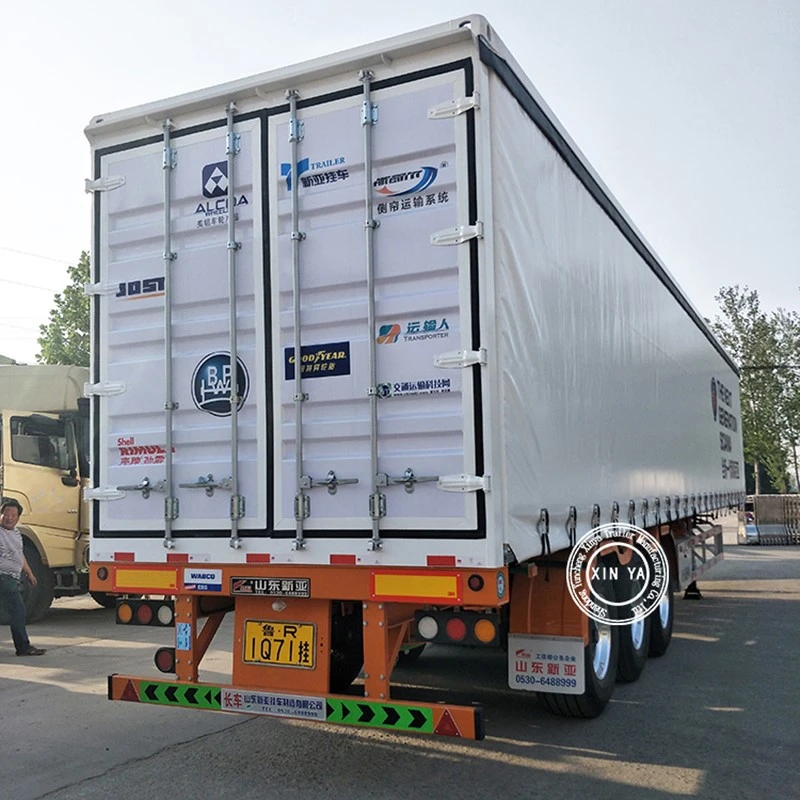
Box-type semi-trailers can be categorized based on their body configuration into integrated (passenger-compartment style) and separated (cargo-box style) types; the former features a unified structure combining the cargo compartment and the cab (e.g., ambulances), while the latter employs a separate structure (e.g., LTL-Less-Than-Truckload-freight vans).
Based on specific functions and structural designs, common types include refrigerated semi-trailers, wing-opening semi-trailers, curtain-side semi-trailers, and container semi-trailers. Wing-opening semi-trailers offer advantages such as rapid loading and unloading, high efficiency, and the capability for side-loading. Container semi-trailers feature a standard container structure for the cargo area, allowing for long-term, repeated use and suitability for multimodal transport.
According to the standard *Classification of Road Cargo Transport Vehicles* (JT/T 1274-2019), road cargo vehicles are classified by structure into categories such as drop-side, box-type, and stake-body types; box-type semi-trailers constitute a major category among them.
While the standard length for semi-trailers is commonly 13 meters, various other specifications exist-including 10m, 11m, 13.75m, 14.6m, 15m, 16m, and 17.5m-subject to the national regulation that the total length (including the tractor unit) must not exceed 17.5 meters.