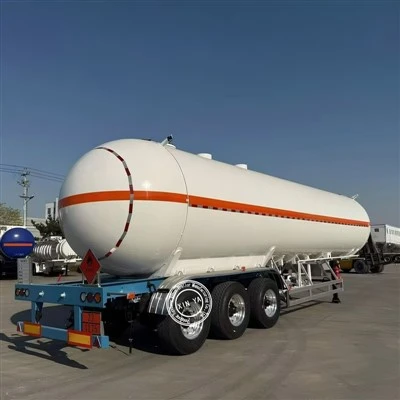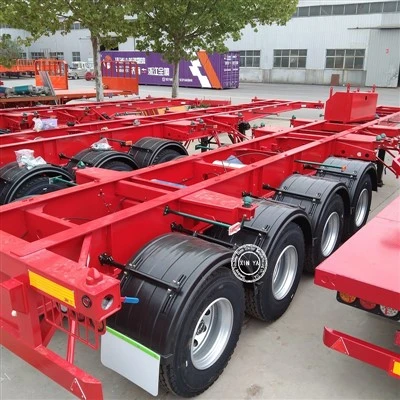
If you've ever watched an excavator roll slowly onto a trailer at a construction site, or seen a heavy-duty load get hauled down a highway without any tipping or swaying, chances are you're looking at a low-bed trailer. As a long-time low-bed truck trailer supplier, I've spent thousands of hours talking with operators, engineers, and logistics teams about what makes these trailers work-and one of the most common questions I get is how their signature low design affects the load center of gravity (CoG). It's not just a fun technical detail; it's the difference between a safe haul and a costly accident. Let's break this down.

First, let's get clear on what "load center of gravity" means. Simply put, CoG is the point where the entire weight of the load (and the trailer itself) is evenly distributed. For a truck and trailer, this point is critical because if it sits too high, the vehicle becomes unstable-especially when turning, changing lanes, or hitting a small bump. A high CoG means more leverage at the wheels, making it easier for the trailer to tip over or sway, especially with heavy, bulky loads like excavators, bulldozers, or large construction equipment. That's where low-bed trailers come in, and their design is built specifically to lower that CoG.
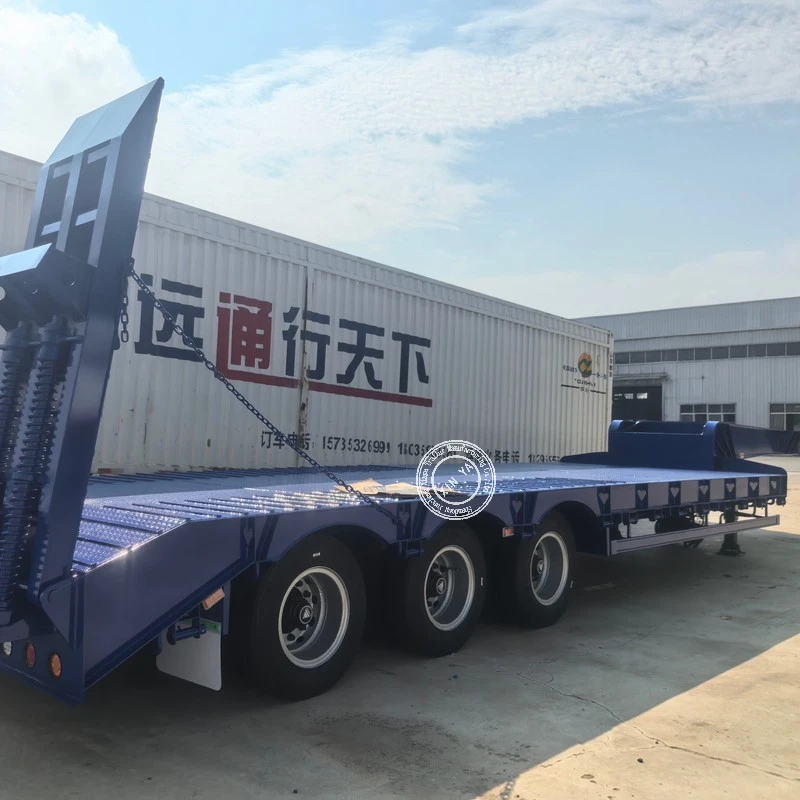
Unlike standard flatbed trailers, which sit high off the ground with deck heights often over 60 inches, low-bed trailers are engineered to have a much lower deck-usually between 18 and 36 inches, depending on the model. This lower deck is the foundation of their ability to manage CoG. When you load heavy equipment like an excavator onto a low-bed, you're not lifting that weight high into the air like you would on a standard flatbed. Instead, the machine sits close to the ground, so its mass is concentrated lower to the pavement. Let's put numbers to that: an average 30-ton excavator has a CoG roughly 48 inches above the ground when resting on its tracks. If you load it onto a standard flatbed with a 60-inch deck, that same load's CoG jumps to 108 inches-almost 9 feet off the ground. Load it onto a low-bed trailer with a 24-inch deck, and suddenly that CoG is only 72 inches, a 33% drop in height. That smaller gap between the load's CoG and the road makes the entire trailer assembly far more stable.
But it's not just about the deck height. The low-bed design works hand-in-hand with the trailer's axle configuration, which is where different models start to matter. For example, if you need to haul extra-heavy loads, a 4 axle lowbed semi trailer is a common choice. More axles mean more wheels to distribute the weight, but they also let the low-bed deck sit even lower without overloading individual tires. Each axle is spaced strategically to keep the CoG centered over the wheels, so the weight doesn't tip too far forward or backward. I've seen first-hand how this works: last year, a customer tried to haul a 50-ton bulldozer on a 3-axle standard low-bed, and the rear axle was crushed under the weight because the deck was too high, pushing the CoG too far back. Swapping to a 4 axle model let them lower the deck 4 inches, centering the load's CoG evenly across all axles and eliminating that stress point.
Another key factor is the type of low-bed trailer you choose for your load. If you're hauling construction equipment like excavators, a lowbed trailer for excavator transport is purpose-built with even lower deck clearance and reinforced ramps to make loading easier. Excavators have a wide, low-slung body, but their weight is concentrated in the tracks and the engine at the rear. A dedicated excavator low-bed lets you position the machine so the heaviest parts sit directly over the trailer's axles, keeping the CoG as low as possible. I've worked with dozens of excavation contractors who swear by these models because they reduce the risk of tipping on winding backroads, where even a small turn can throw a high CoG load off balance.
For even heavier loads, like 60-ton lowbed semi-trailer units, the design gets more precise. These trailers often have a gooseneck that sits lower than standard, a extended wheelbase, and multiple axles spread out to manage CoG. The gooseneck- the part that connects to the truck tractor-adds extra support at the front of the trailer, which helps balance the load so it doesn't slide too far forward. When you're hauling 60 tons, a shift of just a few inches in the CoG can put too much weight on the tractor's rear wheels, making steering hard, or too little, making the trailer sway. That's why these models are engineered to keep the load's CoG within a narrow window, usually 18 to 24 inches above the trailer deck, to meet highway safety standards.
Multi axle low bed semi-trailer take this a step further, with 5 or more axles designed for extra-heavy, oversized loads like cranes or heavy mining equipment. The extra axles not only distribute weight to avoid overloading laws, but they also let the deck stay low even as the load gets bigger. For example, a 5-axle low-bed can lower the deck an extra 2 inches compared to a 3-axle model, dropping the load's CoG proportionally. I've had clients hauling 80-ton mining trucks that rely on multi axle models to keep CoG low enough to travel on state highways without special oversize-permit restrictions. Higher CoG loads usually require permits for slow-moving vehicles, but lower CoG means they can travel at normal highway speeds, cutting down on transport time and costs.
It's important to note that low-bed design doesn't just work for heavy loads-it also affects CoG for smaller, lighter loads too. For example, if you're hauling construction materials like steel beams or prefab walls, a low bed truck trailer lets you stack materials lower than a standard flatbed, keeping the overall CoG of the trailer lower. Even a small 10% drop in CoG can make a big difference in stability when carrying tall, narrow loads that have a natural high CoG. I once had a customer hauling 20-foot steel beams on a standard flatbed that kept getting blown sideways by crosswinds; switching to a low-bed let them stack the beams flat on the deck, dropping the overall CoG and eliminating that sway.
Of course, low-bed design isn't a one-size-fits-all solution. The trade-off is that a lower deck means less ground clearance for rough terrain, which is a consideration for construction sites with uneven dirt or rock. That's why operators have to match the trailer type to their load and route-something I always emphasize when talking to potential buyers. For example, if you're working on a remote rural site with unpaved access, a slightly higher low-bed model with a small ground clearance boost might be better, even if it means a slightly higher CoG. The key is balancing CoG stability with the needs of your specific job.
As a supplier, I've seen how small design choices make a huge impact on CoG. For example, some low-bed trailers have a removable deck section that lets you carry oversize loads without raising the overall CoG, while others have reinforced cross members that keep the deck rigid, so the load doesn't shift mid-transport-another factor that affects CoG. Even the ramp design matters: if ramps are too steep, loading an excavator can lift the rear tracks high, temporarily raising the CoG. Dedicated excavator transport low-bed trailers have gently sloping ramps that minimize this lift, making loading safer and keeping CoG as low as possible during transit.
Safety is the biggest reason CoG matters, and low-bed trailers are engineered to meet global safety standards that require CoG calculations for heavy loads. In the U.S., for example, the Federal Motor Carrier Safety Administration (FMCSA) has specific rules for load CoG and trailer stability, and low-bed designs often help operators stay compliant. A standard flatbed with a high CoG load is more likely to fail these stability tests, leading to fines or even accidents. I've had customers tell me that switching to low-bed trailers cut their accident rate by 40% because of the improved CoG management.
Now, if you're in the market for a trailer that works with your load, understanding how low-bed design affects CoG is essential. Whether you need a lowbed trailer for excavator transport, a 4 axle lowbed semi trailer for heavy equipment, or a 60 ton lowbed semi-trailer for oversized loads, the right design will keep your CoG low, your loads stable, and your drivers safe. As a low-bed truck trailer supplier, I'm here to help you pick the right model for your specific needs. If you have questions about which trailer will work best for your loads, feel free to reach out to discuss your requirements, no obligation needed.
References:
- Federal Motor Carrier Safety Administration. (2022). Heavy Vehicle Stability and Load Center of Gravity Guidelines. U.S. Department of Transportation.
- Construction Equipment Association. (2021). Low-Bed Trailer Design and Load Stability for Heavy Equipment Transport. London: CEA Publications.
- SAE International. (2020). Technical Paper: The Impact of Trailer Axle Configuration on Load Center of Gravity and Highway Safety. Warrendale, PA: SAE International.
- National Highway Traffic Safety Administration. (2023). Oversized Load Transport: CoG Calculations and Compliance Standards. Washington, D.C.: NHTSA.
- International Association of Heavy Transport Operators. (2022). Best Practices for Low-Bed Trailer Load Management. Amsterdam: IAHTO Press.